
Cabinet Types: The Complete Guide to Every Style & Layout
From base cabinets to wall units, tall pantries to corner solutions — discover every cabinet type, understand how they work, and choose the perfect configuration for your kitchen, bathroom, or storage space.
Explore Cabinet TypesWhy Cabinet Types Matter: Choosing the right cabinet type is the foundation of every functional kitchen or storage space. The type of cabinet determines not just how your room looks, but how efficiently you can store, organize, and access your belongings every single day. This guide breaks down every major cabinet category so you can make an informed decision before you buy.
What Are Cabinet Types?
Cabinet types refer to the different categories of cabinetry based on their function, placement, and construction. In a standard kitchen, cabinets are typically divided into base cabinets (floor-mounted), wall cabinets (mounted above the counter), and tall cabinets (floor-to-ceiling units). Each type serves a distinct purpose and is engineered to handle specific storage needs.
Beyond the kitchen, cabinet types extend to bathroom vanities, laundry room storage, garage cabinets, bedroom wardrobes, and specialty units like corner cabinets and lazy Susans. Understanding the full range of cabinet types helps you plan a layout that maximizes every square foot of your space.

A visual breakdown of the main cabinet types found in modern kitchens and storage spaces.
Base Cabinets
Base cabinets are the workhorses of any kitchen. They sit directly on the floor and support your countertop, making them the primary storage for pots, pans, small appliances, and everyday cookware. Standard base cabinets are typically 24 inches deep and 34.5 inches tall, with a 1.5-inch countertop bringing the total working height to 36 inches.
Base cabinets come in several configurations, including drawer banks, door-and-shelf combinations, and specialty units designed for sinks, trash cans, or corner access. They are the most heavily used cabinet type and should be chosen for durability and ease of access. If you are planning a full kitchen renovation, our kitchen cabinets guide covers how base cabinets integrate into a complete layout.
Popular Base Cabinet Configurations
- Drawer banks — ideal for utensils, linens, and small items
- Door-and-shelf units — best for larger pots and appliances
- Sink base cabinets — designed with cutouts for plumbing
- Corner base cabinets — maximize dead corner space (see corner cabinets guide)
- Pull-out base cabinets — add sliding shelves for easier access (see pull-out cabinet shelves)
Wall Cabinets
Wall cabinets are mounted above the countertop and typically measure 12 inches deep and 30 to 42 inches tall. They provide overhead storage for dishes, glassware, spices, and dry goods. Because they are mounted at eye level, wall cabinets are ideal for frequently used items.
The height of wall cabinets significantly affects both storage capacity and visual balance. Standard 30-inch wall cabinets leave space above for display, while 42-inch cabinets extend closer to the ceiling for maximum storage. For design inspiration, explore our guide on cabinets with LED lighting to see how under-cabinet lighting transforms wall cabinets.
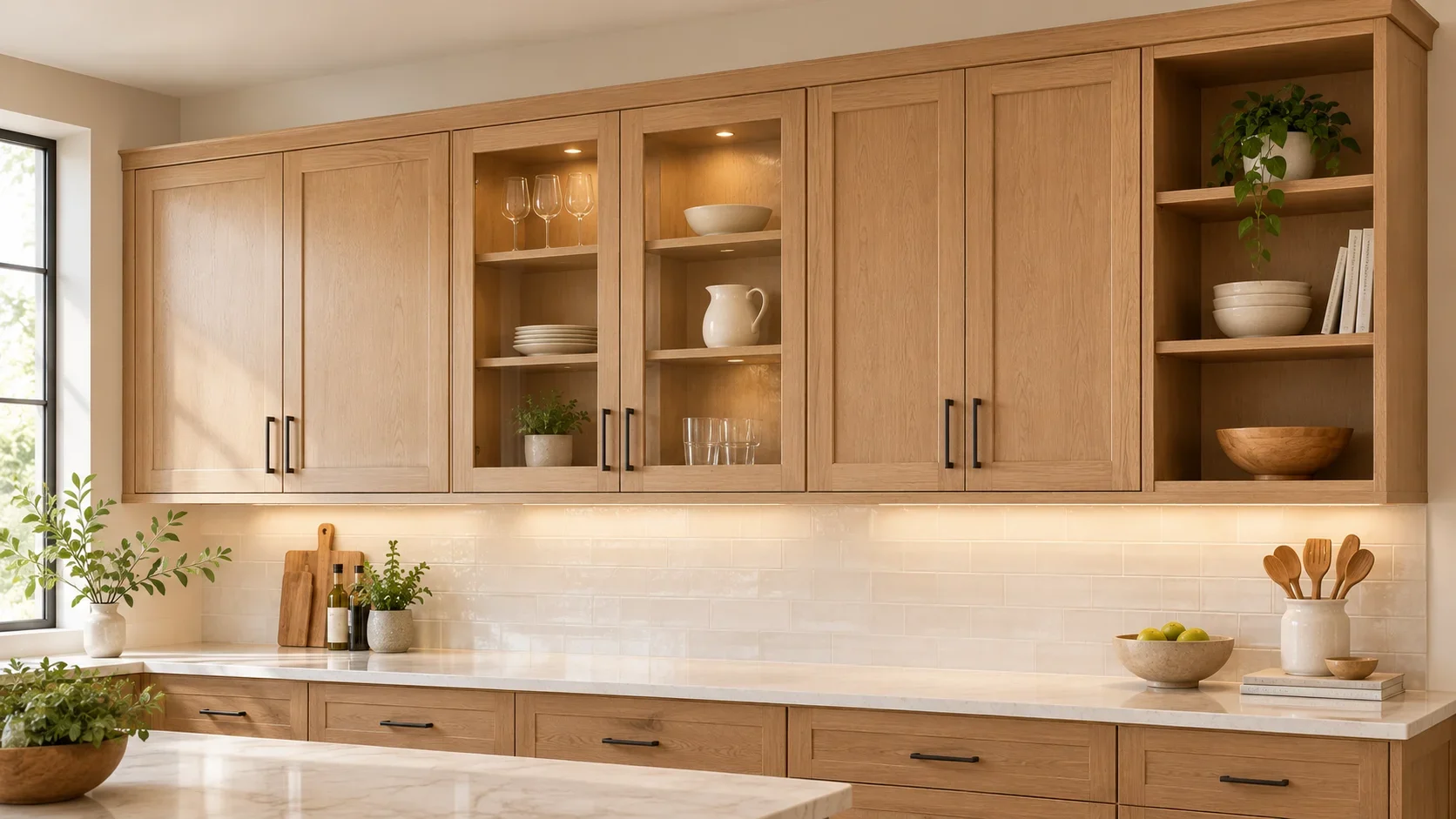
Wall cabinets come in standard, glass-front, and open configurations to suit different storage and design needs.
Tall Cabinets
Tall cabinets run from floor to near-ceiling height and serve as the primary storage for pantry items, brooms, cleaning supplies, and larger appliances. Standard tall cabinets are 84 to 96 inches high and 12 to 24 inches deep. They are especially valuable in kitchens with limited pantry space.
Tall cabinets can be configured as single-door, double-door, or with a combination of shelves and drawers. A well-designed tall cabinet can replace an entire closet, making it one of the most space-efficient cabinet types available. For kitchen-specific storage, see our pantry cabinets guide.
Types of Tall Cabinets
- Pantry cabinets — dedicated dry food and supply storage
- Oven cabinets — built to house wall ovens at comfortable heights
- Utility cabinets — for brooms, mops, and cleaning supplies
- Wardrobe cabinets — bedroom and hallway storage
- Refrigerator surround cabinets — integrate a fridge into the cabinetry
Corner Cabinets
Corner cabinets are designed to utilize the awkward corners where two cabinet runs meet. Without proper planning, these corners become dead space. Corner cabinet types include L-shaped base cabinets, diagonal corner cabinets, and corner wall units. Many modern corner cabinets feature pull-out mechanisms or lazy Susans to make every inch accessible.
For a complete breakdown of corner solutions, see our corner cabinets guide and lazy Susan cabinets resource.
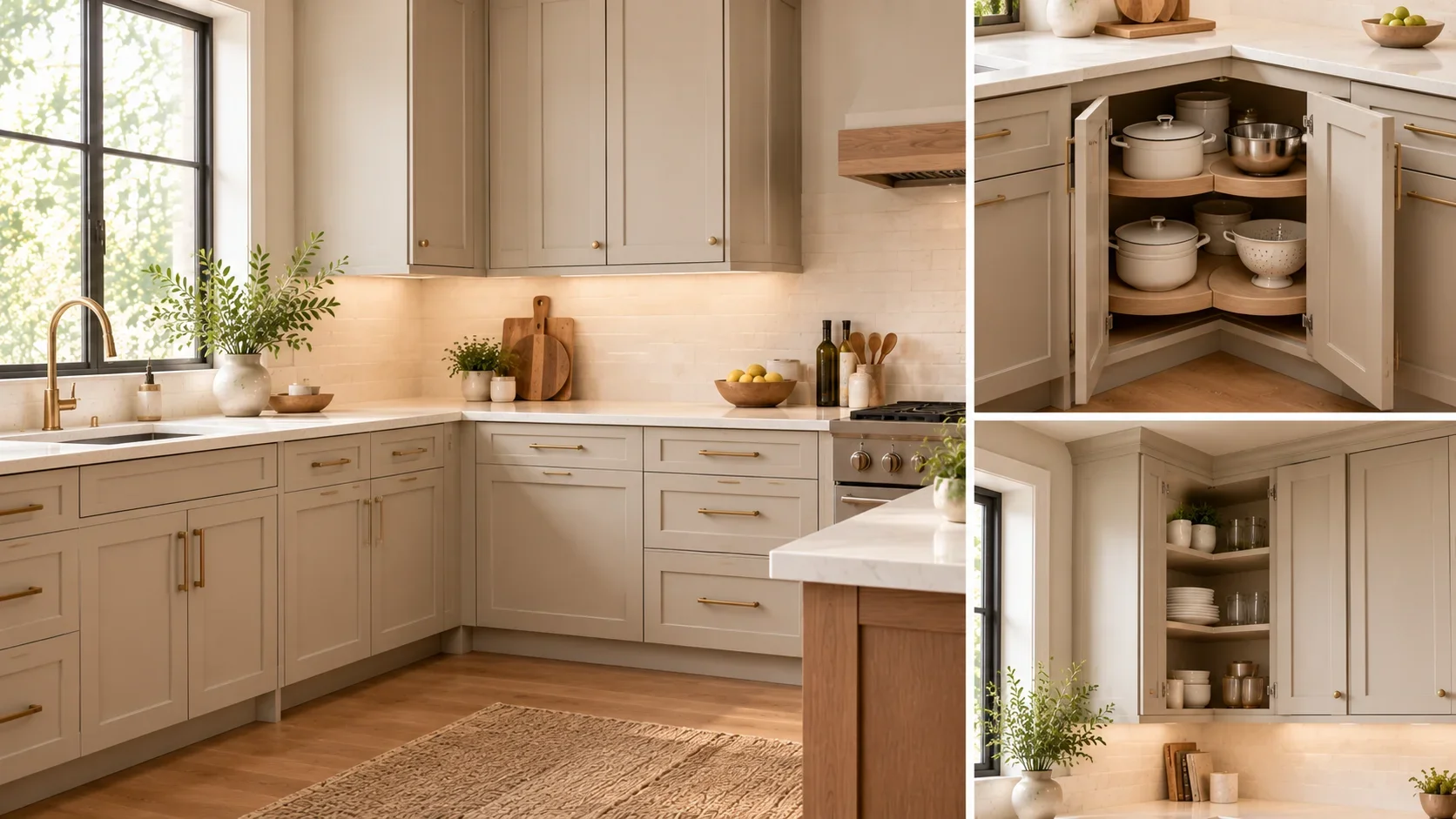
Corner cabinet solutions turn dead space into functional storage with pull-outs and lazy Susans.
Cabinet Types by Room
The same cabinet principles apply across every room, but each space has unique requirements. Kitchen cabinets prioritize durability and access, bathroom vanities need moisture resistance, and garage cabinets demand heavy-duty construction.
Kitchen Cabinets
The most common cabinet type. Kitchen cabinets include base, wall, tall, and corner units, often combined with specialty cabinets like cabinets with USB ports and cabinets with LED lighting.
Bathroom Vanity Cabinets
Bathroom vanities combine a sink base with storage. They must resist moisture and humidity. Explore bathroom vanity cabinets for style and material options.
Bedroom Storage Cabinets
Wardrobes, armoires, and bedside cabinets fall into this category. See bedroom storage cabinets for layout ideas.
Laundry Room Cabinets
Designed for detergents, cleaning tools, and folding surfaces. Our laundry room cabinets guide covers layout and material choices.
Garage Storage Cabinets
Heavy-duty cabinets built for tools, sports gear, and seasonal items. See garage storage cabinets for durable options.
Pantry Cabinets
Dedicated food storage with adjustable shelving and pull-outs. Explore the pantry cabinets guide for complete details.
Cabinet Types by Door Style
The door style defines the visual character of your cabinets. While not strictly a "type" of cabinet, door style dramatically affects the overall look and is often the first decision buyers make. The most popular styles include:
| Door Style | Look | Best For |
|---|---|---|
| Raised Panel | Traditional, ornate | Classic and formal kitchens |
| Flat Panel | Clean, modern | Contemporary and minimalist spaces |
| Glass Front | Elegant, display-oriented | China, glassware, and decorative items |
| Beadboard | Coastal, cottage | Farmhouse and beach-style kitchens |
| Thermofoil | Smooth, uniform | Budget-friendly modern kitchens |
Cabinet Types by Design Style
Beyond function, cabinet types are often categorized by design style. This helps buyers narrow down options based on the aesthetic of their home. The most sought-after styles include:
Modern Kitchen Cabinets
Clean lines, flat fronts, and minimal hardware. Modern cabinets often use glossy or matte finishes and integrated handles. See modern kitchen cabinets for full examples.
Rustic Kitchen Cabinets
Natural wood grains, distressed finishes, and sturdy construction. Ideal for farmhouse and cabin-inspired homes. Explore rustic kitchen cabinets.
Shaker Kitchen Cabinets
Five-piece doors with a recessed center panel. Shaker cabinets are the most versatile style and work in both traditional and modern settings. See shaker kitchen cabinets.
Industrial Kitchen Cabinets
Metal accents, exposed hardware, and raw materials. Industrial cabinets suit loft-style and urban kitchens. See industrial kitchen cabinets.
Minimalist Kitchen Cabinets
Handleless doors, integrated appliances, and monochromatic palettes. Minimalist cabinets create a calm, uncluttered look. Explore minimalist kitchen cabinets.
Cabinet Types by Kitchen Layout
The layout of your kitchen determines which cabinet types you need and how they should be arranged. The most common layouts include:
- L-shaped kitchens — two adjoining runs of cabinets; see L-shaped kitchen cabinets
- U-shaped kitchens — three runs of cabinets for maximum storage; see U-shaped kitchen cabinets
- Galley kitchens — two parallel runs; see galley kitchen cabinets
- Small kitchens — compact base and wall units; see small kitchen cabinets
- Large kitchens — expansive layouts with islands and tall cabinets; see large kitchen cabinets
Cabinet Types by Material
The material of your cabinet box and door affects durability, price, and appearance. Common materials include solid wood, plywood, particle board, and MDF. For a full breakdown, see our cabinet material hub.
- Solid wood cabinets — premium durability and natural beauty; see solid wood cabinets
- Plywood cabinet boxes — strong, moisture-resistant; see plywood cabinet boxes
- Particle board cabinets — budget-friendly; see particle board cabinets
- MDF cabinet boxes — smooth and uniform; see MDF cabinet boxes
- Metal cabinet frames — industrial and commercial use; see metal cabinet frames
Specialty Cabinet Types
Beyond the standard categories, several specialty cabinet types address specific storage challenges. These include:
Lazy Susan Cabinets
Rotating shelves that make corner storage fully accessible. See lazy Susan cabinets.
Cabinets with USB Ports
Built-in charging for devices. See cabinets with USB ports.
Cabinets with LED Lighting
Integrated lighting for visibility and ambiance. See cabinets with LED lighting.
Pull-Out Cabinet Shelves
Sliding shelves that bring items to you. See pull-out cabinet shelves.
How Much Do Cabinet Types Cost?
Cabinet prices vary widely depending on type, material, and customization. Below is a general price guide for common cabinet types in the current market:
Base Cabinets: $150–$800 per unit (stock) | $400–$1,500 (semi-custom)
Wall Cabinets: $100–$600 per unit (stock) | $300–$1,200 (semi-custom)
Tall Cabinets: $400–$1,800 per unit | $1,200–$3,500 (custom)
Corner Cabinets: $250–$900 per unit | $600–$2,000 (custom pull-out)
Bathroom Vanity Cabinets: $200–$1,200 per unit | $800–$3,000 (luxury)
Full Kitchen (10x10): $2,500–$8,000 (stock) | $8,000–$25,000+ (custom)
Prices are estimates and vary by region, brand, and material. Always request quotes from multiple suppliers before purchasing. For detailed pricing, see our cabinet spec glossary and cabinet dimension chart.
Buying Tips for Cabinet Types
Before purchasing cabinets, consider the following expert tips:
- Measure twice — use our cabinet dimension chart to confirm sizes.
- Check clearance — see cabinet appliance clearance for safe spacing.
- Plan the layout — use the cabinet placement guide for optimal positioning.
- Consider installation — review the cabinet installation guide before buying.
- Avoid common mistakes — read cabinet buying mistakes.
- Start with a checklist — use the first cabinet checklist.
Recommended Cabinet Types & Storage Solutions
⚠️ AFFILIATE DISCLOSURE: This website contains affiliate links. As an affiliate Associate, we earn from qualifying purchases. If you make a purchase through these links, we may receive a small commission at no additional cost to you. Read our full affiliate policy.

Built-in Cabinetry Door Frame Type Cabinet Door White(24in.H x 12in.W) | Premium Wood,Replacement Door for Kitchen,Living Room, Bedroom,Restaurant and Other Scenes,Can be Directly Installed and Used
Check price on Amazon
Built-in Cabinetry Door Frame Type Cabinet Door White(29in.H x 11.5in.W) | Premium Wood,Replacement Door for Kitchen,Living Room, Bedroom,Restaurant and Other Scenes,Can be Directly Installed and Used
Check price on Amazon
Built-in Cabinetry Door Frame Type Door White Texture(29in.H x 19.25in.W) | Premium Materials,Replacement Cabinet Door for Home,Office,School and 0ther Scenarios,Can be Directly Installed and Used
Check price on Amazon
2 Sets Purocean Level Handle Cam Lock,L-Type Locking Door Handle,Cabinet Handle Lock Chrome (PX058 Right)
Check price on Amazon
Generic Finger Pull Bit for Finger Grip of Drawer Wardrobe Cabinet-Type Door Industral-Grade (1/4" Shank Flat Bottom)
Check price on Amazon
Round Steel Mounting Side Brackets Compatible with Wilson Cabinets | Sold in Pairs | Antique Reproduction Hardware for Hoosier Type Kitchen Cabinet | UA-785-S
Check price on AmazonFrequently Asked Questions About Cabinet Types
What is the most common cabinet type?
Base cabinets are the most common cabinet type. They sit on the floor, support the countertop, and provide the primary storage for pots, pans, and everyday items. Wall cabinets are the second most common, providing overhead storage.
What is the difference between base and wall cabinets?
Base cabinets are floor-mounted and support the countertop, typically 24 inches deep and 34.5 inches tall. Wall cabinets are mounted above the counter, usually 12 inches deep and 30 to 42 inches tall. Base cabinets store heavier items; wall cabinets store lighter, frequently used items.
Which cabinet type is best for small kitchens?
For small kitchens, tall cabinets and corner cabinets with pull-out mechanisms maximize vertical and corner space. Wall cabinets that extend to the ceiling also add significant storage without increasing the footprint. See our small kitchen cabinets guide for detailed recommendations.
Are custom cabinets worth the extra cost?
Custom cabinets are worth it if you have unusual dimensions, specific storage needs, or want a fully integrated look. For standard kitchens, semi-custom or stock cabinets offer excellent value. Compare options in our stock vs custom cabinets guide.
How do I choose the right cabinet door style?
Door style should match your overall design aesthetic. Shaker doors work in almost any setting. Raised panel suits traditional homes. Flat panel and slab doors fit modern and minimalist spaces. Glass-front cabinets are ideal for display items. See our cabinet hardware guide for complementary hardware choices.