
2 Tone Cabinets: The Complete Guide to Two-Tone Kitchen & Bath Design
Everything you need to know before choosing two-tone cabinets — color pairings, materials, costs, and expert design tips for a showroom-worthy space.
START LEARNINGWhat Are 2 Tone Cabinets? Two-tone cabinets use two different colors or finishes within a single kitchen or bathroom layout — most commonly a lighter shade on upper cabinets and a deeper shade on lower cabinets. This design approach adds visual depth, breaks up heavy runs of cabinetry, and lets you express personal style without a full custom renovation. Whether you are planning a modern rustic kitchen or refreshing a compact bath, understanding how two-tone layouts work is the first step toward a space that feels intentional and balanced.
Why Homeowners Choose Two-Tone Cabinetry
Two-tone cabinets have moved from a passing trend to a mainstay in residential design. The appeal is practical as much as aesthetic. A contrasting upper and lower palette can make a small kitchen feel taller, ground a large open-plan space, or subtly separate a cooking zone from a living area. Below are the four reasons designers return to this approach again and again.
Visual Depth & Balance
A darker base with lighter uppers draws the eye upward, making ceilings appear higher and rooms feel more spacious. This is especially effective in galley and L-shaped kitchens where cabinet runs can otherwise feel monotonous.
Zone Definition
In open-concept homes, two-tone cabinetry quietly separates functions — a perimeter run in one finish and an island or bar hutch cabinet in another. The color change signals a shift in purpose without adding walls.
Budget-Friendly Impact
Instead of replacing an entire kitchen, many homeowners achieve a two-tone look by keeping existing boxes and swapping just the doors. This is where replacement kitchen cupboards and drawers or professional cabinet refacing contractors deliver high visual return for a fraction of full replacement cost.
Personal Expression
Two-tone layouts let you introduce a signature color — a deep navy, sage green, or warm charcoal — while keeping the majority of the room neutral. It is a controlled way to add personality without overwhelming a resale-friendly palette.
The Most Popular Two-Tone Color Pairings
The success of a two-tone kitchen depends almost entirely on how the two finishes relate to each other. High-contrast pairings feel bold and graphic; low-contrast pairings feel calm and tonal. The following combinations consistently perform well in real homes and are widely available across stock, semi-custom, and custom lines.
- White + Navy Crisp white uppers with deep navy lowers. The classic high-contrast pairing that works in coastal, transitional, and modern homes. Pair with brass or brushed nickel hardware.
- White + Sage Green Soft white uppers with muted green lowers. A nature-inspired combination that suits farmhouse and modern rustic interiors without feeling dated.
- Cream + Walnut Warm cream uppers with natural wood lowers. A wood-tone lower cabinet, such as an oak stained cabinet finish, brings organic warmth that painted finishes alone cannot replicate.
- Grey + White Light grey uppers with white lowers (or the reverse). A low-contrast, versatile option that reads as soft and contemporary. Works well with grey kitchen units as a base.
- Black + Natural Wood Matte black uppers with warm oak or walnut lowers. A dramatic, design-forward pairing that suits industrial and modern spaces. Pair with black or matte hardware.
- Tonal Whites Warm white uppers with cool white lowers. A subtle, almost monochromatic approach that adds dimension without a visible color break.
How to Decide Which Cabinet Goes Dark and Which Goes Light
There is no single rule, but there are reliable guidelines. If your goal is to make the room feel taller, keep uppers lighter and lowers darker — the eye travels upward toward the lighter mass. If you want to ground a space with a bold statement, invert it: dark uppers and light lowers create a top-heavy look that works in rooms with very high ceilings where visual weight is needed up top.
Another factor is door style. If you are choosing between flat and detailed fronts, review types of cabinet doors and kitchen cabinet door style options before locking in a palette. A shaker door in two colors reads differently than a flat slab in the same pairing, and the finish you choose — painted, stained, or laminate — changes how the contrast registers in natural light.
Also consider the surrounding surfaces. Countertops, backsplash, and flooring either support or fight the two-tone scheme. A busy patterned countertop can clash with strong cabinet contrast, so a durable kitchen countertop in a quiet, solid tone is often the safer partner for a bold two-tone kitchen.
Two-Tone Cabinets in Bathrooms & Other Rooms
The two-tone concept is not limited to kitchens. Bathroom vanities increasingly use a contrasting base and door finish, or pair a painted vanity with a natural wood frame. A farmhouse vanity with a painted base and a wood top is a common example. Smaller baths benefit from the same height illusion — a small powder room vanity in a light upper finish and darker base can feel more generous than a single solid color.
Beyond the kitchen and bath, two-tone storage appears in living rooms and dining spaces. A white sideboard cabinet with a contrasting wood top, or a tall sideboard cabinet with a painted frame and natural doors, carries the same design logic into other rooms. Even a black cabinet paired with lighter interior shelving is a form of two-tone treatment that adds depth to a single piece.
Pros and Cons of Two-Tone Cabinets
Two-tone cabinetry is not the right choice for every home. Before committing, weigh the genuine benefits against the practical trade-offs so the result matches your long-term plans.
Advantages
- Adds visual interest without structural changes
- Makes ceilings and rooms feel larger
- Defines zones in open-plan layouts
- Lets you use a bold color in a controlled way
- Can be achieved through refacing or door replacement
- Works across farmhouse, modern, coastal, and transitional styles
Trade-Offs to Consider
- Requires more design decisions than a single finish
- Resale appeal is not universal — some buyers prefer uniform cabinetry
- Contrast can make small imperfections more noticeable
- Hardware and countertop choices become more constrained
- Mismatched undertones between the two colors can look accidental
What Do 2 Tone Cabinets Cost?
Cost depends on whether you are painting existing cabinets, refacing, or buying new. Two-tone finishes do not inherently cost more than single-color cabinetry when ordered new — the price is driven by material, construction, and brand tier, not the number of colors. The table below reflects typical market pricing for a standard kitchen.
| Approach | Typical Cost | Best For |
|---|---|---|
| DIY painting existing cabinets | $300–$900 | Budget-conscious refreshes with sound boxes |
| Professional cabinet refacing | $2,500–$6,500 | Keeping existing layout, changing look |
| Stock two-tone cabinets | $1,800–$4,500 | Standard sizes, quick turnaround |
| Semi-custom two-tone cabinets | $4,500–$12,000 | Non-standard sizes, specific finishes |
| Full custom two-tone cabinetry | $12,000+ | Unique layouts, premium materials |
If your existing cabinet boxes are solid and the layout works, refacing or repainting is almost always the most cost-effective route to a two-tone look. If the boxes are damaged or the layout needs to change, new cabinetry is the better investment. For bathrooms, a discount bathroom vanity or a bathroom vanity cabinet only purchase can keep a two-tone bath refresh well under budget.
Hardware & Finish Pairings for Two-Tone Kitchens
Hardware is where a two-tone kitchen either feels resolved or slightly off. The safest approach is to choose one metal finish for the entire room and let the cabinet colors carry the contrast. Mixing metals is possible but demands more care. Popular pairings include matte black pulls on white uppers with brass on the island, or brushed nickel throughout for a quieter look. Explore modern kitchen cabinet pulls and black drawer pulls to see how hardware finish shifts the overall tone of a two-tone layout. For bathroom two-tone vanities, bathroom vanity hardware in a single finish keeps the look cohesive. A cabinet pull jig is a worthwhile investment if you are installing hardware yourself across two different cabinet colors.
Design Mistakes to Avoid with 2 Tone Cabinets
Most two-tone disappointments trace back to a small number of avoidable errors. First, ignoring undertones: a warm white upper paired with a cool grey lower can look muddy rather than intentional. Second, over-contrasting in a small room — high contrast shrinks a compact kitchen, so low-contrast tonal pairings are safer in tight spaces. Third, forgetting the third surface: the countertop, backsplash, and floor must all coexist with both cabinet colors. Fourth, choosing hardware that competes with the color break instead of supporting it. Finally, treating the island as an afterthought — if the island is a third color rather than one of the two, the room can feel busy rather than balanced. Planning the full palette before ordering a single door is the most reliable way to avoid these pitfalls.
Ready to Shop Two-Tone Cabinets?
Browse our curated selection of two-tone and complementary cabinetry below, with current pricing and direct links to trusted retailers.
VIEW RECOMMENDED CABINETSFrequently Asked Questions About 2 Tone Cabinets
Are two-tone cabinets still in style?
Yes. Two-tone cabinetry has matured from a trend into a recognized design approach. It remains widely used in kitchens, bathrooms, and storage furniture because it solves real problems — adding depth, defining zones, and allowing a controlled accent color. The specific color pairings evolve, but the technique itself is durable.
Should upper or lower cabinets be darker?
For most rooms, darker lowers with lighter uppers is the safer default because it makes the space feel taller and grounds the base of the kitchen. Darker uppers with lighter lowers works in rooms with very high ceilings or where you want a dramatic, top-weighted look.
Can I make my existing cabinets two-tone without replacing them?
Absolutely. Painting the existing doors and boxes, or using a refacing service that replaces door and drawer fronts while keeping the boxes, are both established routes to a two-tone result. This is typically far less expensive than full replacement and is a common approach for homeowners with structurally sound cabinetry.
Do two-tone cabinets hurt resale value?
Not inherently, but it depends on the pairing and the local market. Neutral, low-contrast two-tone schemes tend to appeal to a broad range of buyers. Very bold or highly personalized color combinations may narrow the buyer pool. If resale is a near-term concern, choose a restrained palette.
What countertop works best with two-tone cabinets?
A quiet, solid or subtly veined countertop is usually the best partner because it lets the cabinetry carry the visual interest. Highly patterned or heavily veined countertops can compete with a strong two-tone contrast. Match the countertop undertone to the dominant cabinet color for a cohesive result.
Recommended Two-Tone & Complementary Cabinets
⚠️ AFFILIATE DISCLOSURE: This website contains affiliate links. As an affiliate Associate, we earn from qualifying purchases. If you make a purchase through these links, we may receive a small commission at no additional cost to you. Read our full affiliate policy.
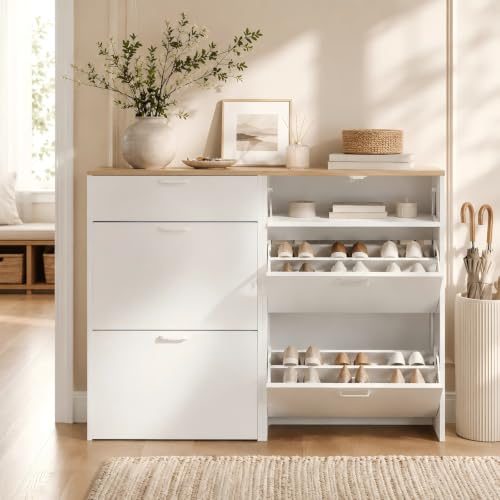
VINGLI Set of 2 Shoe Cabinets Storage for Entryway,2-Pack,White | 16–24 Pairs,Skirting Board Cutout,Drop-Down Drawer,9.4"D Slim,Two-Tone Oak&White,2 Flip Drawers,Adjustable & Removable Shelf
Check price on Amazon
Yoluxe 31.5" Arched Fluted Accent Cabinet, Walnut-Tone Storage Cabinet | Arched fluted accent cabinet with compact 2-door storage, walnut-tone finish and marble-inspired top for small spaces.
Check price on Amazon
63'' Arched Door Sideboard Buffet Cabinet with Drawers, Black and Natural | Modern Farmhouse, Two-tone, Removable Shelves, Metal Handle, Large Storage Space, Wooden Storage Cabinet, Coffee Bar Station
Check price on Amazon
Fender Tone Master FR-212 1,000 Watt 2 x 12-inch Powered Speaker Cabinet | FRFR powered speaker cabinet, 1000W, 2x12-inch, ideal for Kemper, Axe-Fx, modeling amps, studio or stage
Check price on Amazon
SILKYDRY Buffet Cabinet, 47" Vintage Sideboard w/Adjustable Shelves(Green) | Mid Century Credenza w/ 3 Drawers, 2 Doors, Anti-tip Kits; Accent Cabinet for Dining Room, Living Room, Entryway & Coffee Bar
Check price on Amazon